

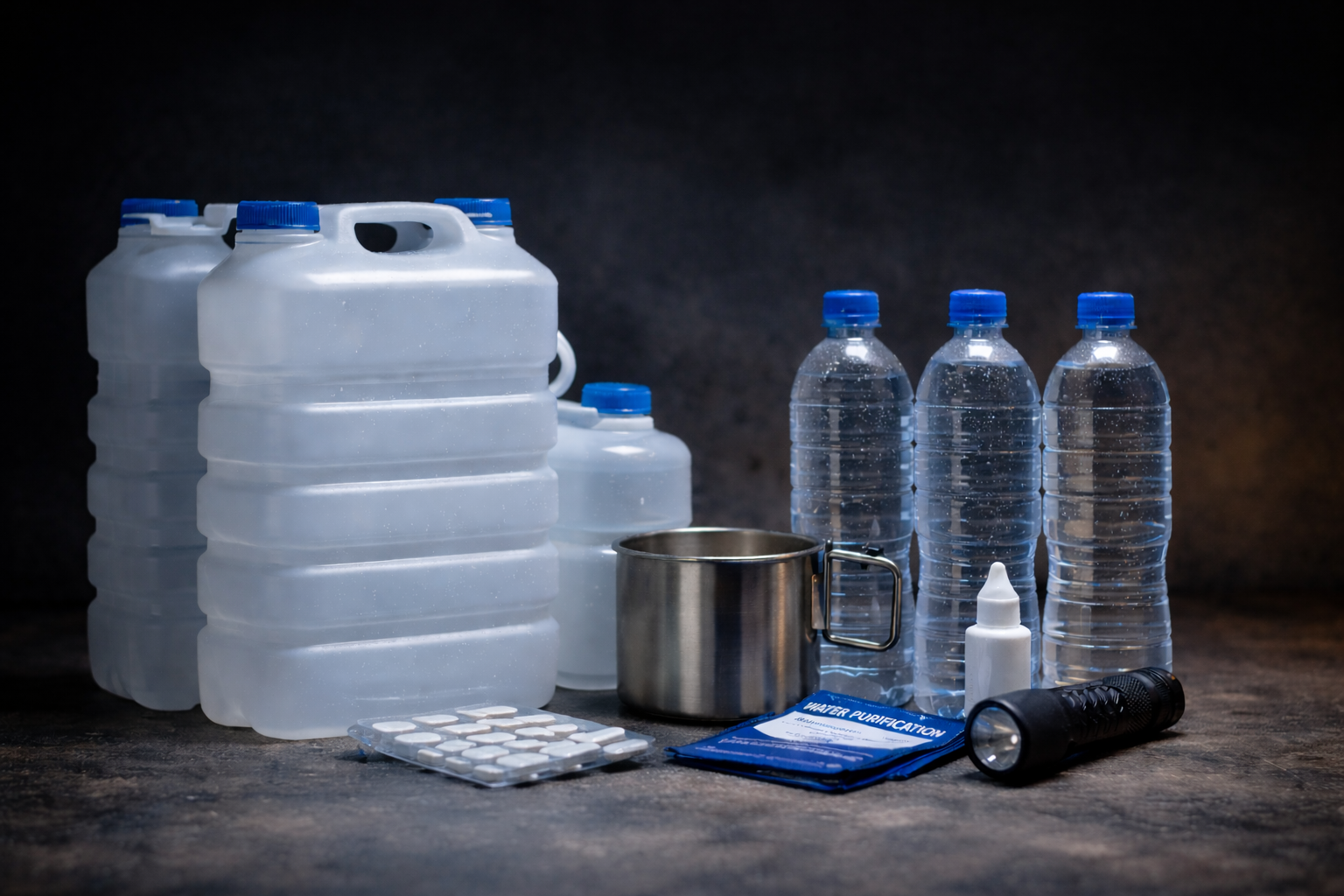
Why Water Comes First
Most households operate with little to no water buffer. Daily activities such as drinking, cooking, hygiene, and cleaning assume uninterrupted access to clean water.
When access is disrupted by weather, power loss, maintenance issues, contamination advisories, or supply delays, options narrow rapidly.
Unlike food, water cannot be meaningfully reduced for long without affecting health and decision-making.
Water preparedness is not about abundance.
It is about time and continuity.
Planning for Realistic Needs
A widely accepted planning baseline is one gallon per person, per day.
This supports:
Drinking
Minimal food preparation
Basic hygiene
This is not a comfort level. It is a functional minimum.
Rather than planning for a single number, effective water preparedness is built in layers:
7–14 days of stored water as a standing household buffer
30 days or more of total capacity through storage, refillability, or redundancy
Not every household can store large volumes. The objective is proportional coverage based on space, climate, household size, and daily needs.
Any amount stored reduces pressure.
Water Storage That Works in Everyday Life
Water storage should be simple, accessible, and maintainable.
Smaller containers are easier to move, rotate, and store in limited spaces. Larger containers improve efficiency but require planning and dedicated space. Both approaches can work.
Regardless of container size, stored water should be:
Kept in clean, food-safe containers
Stored in a cool, dark location
Rotated periodically to remain usable
Preparedness fails quietly when water is forgotten, inaccessible, or assumed to last indefinitely.
Stored Water Is the First Layer — Not the Only One
Stored water provides a buffer.
Purification provides continuity.
Longer disruptions, compounding events, or higher-than-expected use require the ability to make additional water safe once stored supplies are exhausted.
This may include:
Filtration
Chemical treatment
Boiling
A combination of methods
No single method addresses all risks. Redundancy matters.
Effective water preparedness allows households to:
Use stored water first
Supplement carefully if needed
Treat uncertain water safely when required
This approach preserves flexibility and prevents rushed decisions.
Existing Water Inside the Home
In many situations, usable water already exists inside the home. Water heaters, pipes, and ice can provide additional short-term capacity if protected from contamination.
Preparedness includes awareness:
Where water exists
How to preserve it
When it is safe to use
Knowledge extends capability without adding storage.
Outdoor and Alternative Sources
Rainwater and natural surface water can provide additional options during extended disruptions. These sources must be treated before use.
Water preparedness does not require reliance on outdoor sources. However, understanding them increases resilience once stored supplies run low.
Optionality strengthens preparedness.
Water as a System
Effective water preparedness is not a stockpile.
It is a system that includes:
Modest storage
Routine rotation
Awareness of existing resources
The ability to purify when necessary
When these elements work together, water preparedness becomes quiet and dependable.
The Takeaway
Water preparedness is foundational. Without it, every other preparedness system degrades quickly.
You do not need unlimited water.
You need enough access, enough time, and enough options.
The most effective water preparedness plans fit real life—and continue working even when normal access changes.